Flores de Mayo in Bohol: A Local’s Guide to the Festival of Flowers
The afternoon air inside Talibon Cathedral smelled like every garden in the province had opened at once. Rows of children in white — small girls in Filipiniana, boys in crisp barong — carried bouquets of roses, sampaguita, and fresh wildflowers toward the altar. Their voices rose together in prayer. The pews were full. Mothers and lolas, church workers and members of different organisations, had dressed in their best to come and honour her.
This is Flores de Mayo in Bohol — and if you happen to be visiting the province during May, you are about to witness something that no travel itinerary fully prepares you for.
Flores de Mayo, which means “Flowers of May” in Spanish, is one of the most deeply felt Catholic celebrations in the Philippines. In Bohol, it runs the entire month of May, touching every municipality, every barangay (village), and every parish church on the island. The faithful gather each evening to pray the Rosary, offer flowers before the image of the Virgin Mary, and — by the end of the month — join the grand Santacruzan procession that marks the festival’s glorious close.
If you want to understand what faith really looks like in this province, come to Bohol travel guide in May.
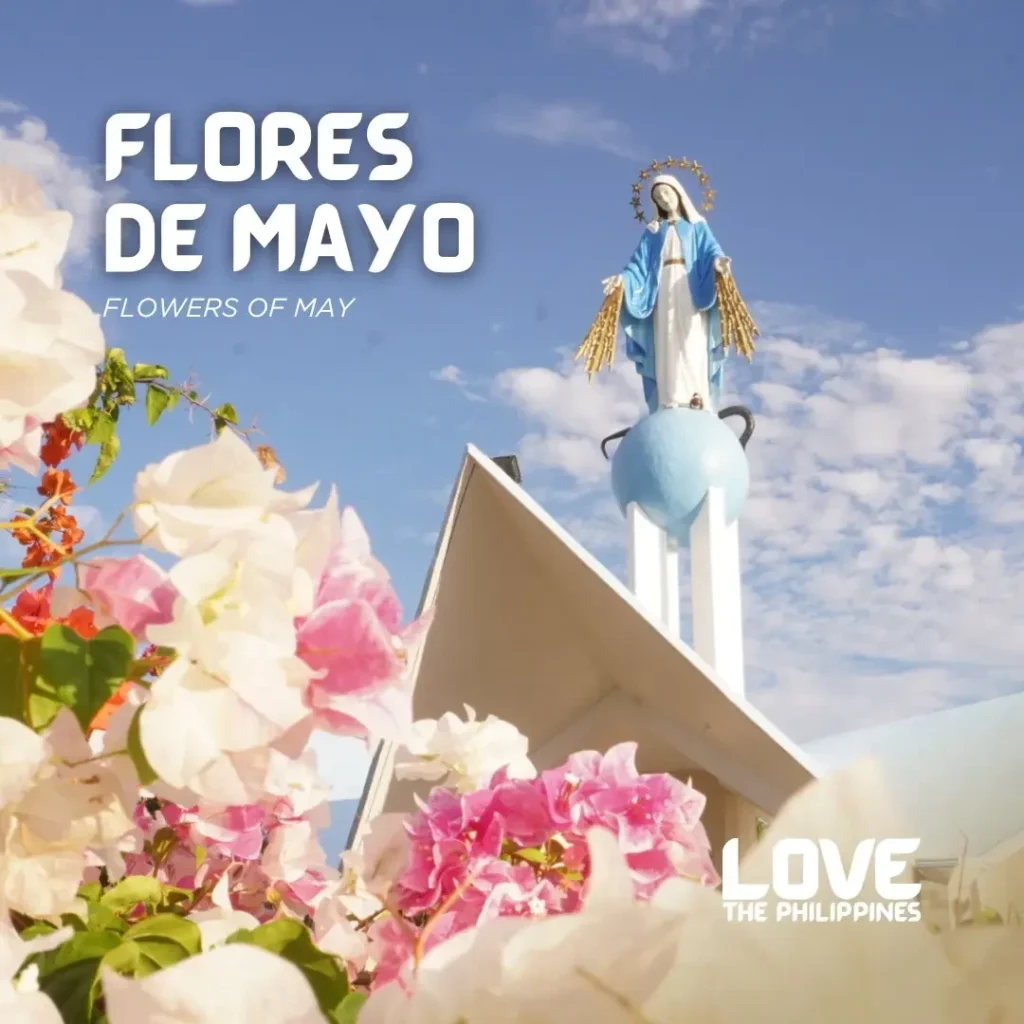
What Is Flores de Mayo?
Flores de Mayo traces its roots to the mid-1800s, when Spanish missionaries introduced it to the Philippines as a month-long devotion to the Blessed Virgin Mary. In 1867, the celebration was formally observed in Malolos, Bulacan — and from there it spread across every Catholic community in the country, taking on its own character in each region.
In Bohol, the festival carries a particular meaning for farmers. Historically, it marks the Virgin Mary’s role as a provider — her intercession bringing the rains that water the rice fields and the coconut groves that feed Boholano families. The month of May sits right at the turning point of Bohol’s seasons: the long dry months of the amihan (northeast monsoon) giving way to the first afternoon thunderstorms of the habagat (southwest monsoon). It is, literally, the moment the land comes back to life.
Faith in Bohol is never separate from everyday life — the same way the Loboc Band has woven music into every religious occasion since 1871, the Flores de Mayo weaves Mary into every evening of the month. You do not observe it from a distance here. You are invited in.
The origins of the celebration are also connected to a specific theological moment: the proclamation of the Dogma of the Immaculate Conception in 1854. The publication of Mariano Sevilla’s book Flores de Maria spread devotion further across the islands. By the time Bohol received the tradition, it was already embedded in the rhythm of Filipino Catholic life.
Eyewitness: The Talibon Cathedral Celebration
“I was not expecting to cry. But when the little angels threw the flower petals and the choir sang and the image of Mary was crowned — I just completely broke down. It was the most moving thing I have experienced in all my years of travelling.”
— Sandra M., traveller from Manila ⭐⭐⭐⭐⭐
If you want to experience Flores de Mayo at its most complete, Talibon Cathedral in northern Bohol is where it comes alive with a fullness that is hard to describe to someone who was not there.
The Cathedral of the Holy Cross in Talibon is a 1986 structure — younger than Bohol’s famous colonial coral-stone churches, but adorned with columns sheathed in garlands of leaves and a facade with rich ornamentation that takes on a particular beauty when dressed for the May devotions. During Flores de Mayo, the interior is transformed by flowers. Not a few vases on the altar — every corner breathes with them.
On the final day of the May celebrations, the Cathedral was, in the words of one participant, “a flurry of activities.” A decade of the Holy Rosary was recited, then the Flores de Mayo novena with flower offerings before the image of Our Lady of All Nations. Then came the procession — beautiful teenage and little girls, some representing the different nations of the world, others carrying banners bearing the different Marian titles. Mothers, church workers, and members of different parish organisations joined the procession in.
What followed was a Pontifical Mass celebrated by His Excellency, Most Rev. Bishop Christian V. F. Noel, D.D., Bishop of Talibon, assisted by Msgr. Jonathan D. Pacudan, Rev. Fr. Adonis L. Madanguit, Rev. Fr. Randy N. Boiser, and Deacon Mark Neil Eronico.
The Bishop’s homily that evening was remarkable. He read, word for word, a homily of Pope Francis on the Blessed Virgin Mary — then translated it line by line into the Bisaya vernacular so that every person in that cathedral could receive the Pope’s words in their own language. Pope Francis called on all Catholic faithful to turn to Mary, for she is the Mediatrix of All Graces. She is our mother. She knows what we need. We have to turn to her for everything — for she is our mediator, and Jesus never refuses his mother anything.
At the end of Mass, the image of the Blessed Virgin Mary was crowned. And then — the moment that silenced the cathedral — the little angels scattered a shower of flower petals over her. The whole month had been building toward that handful of petals drifting down in the candlelight.
The celebration did not end there. The next day, a children’s bazaar was held. All those who had attended the month-long activities had been given tickets throughout May, and they could now exchange those tickets for school supplies — notebooks, pens, crayons — in time for the approaching school year. The children were treated to refreshments. A month of catechism, a crown of flowers, and a school bag on the way out. That is Flores de Mayo in Bohol.
[This eyewitness account was written by community journalist Ellen Marie O. Buno.]
The Santacruzan: Bohol’s Grand May Procession
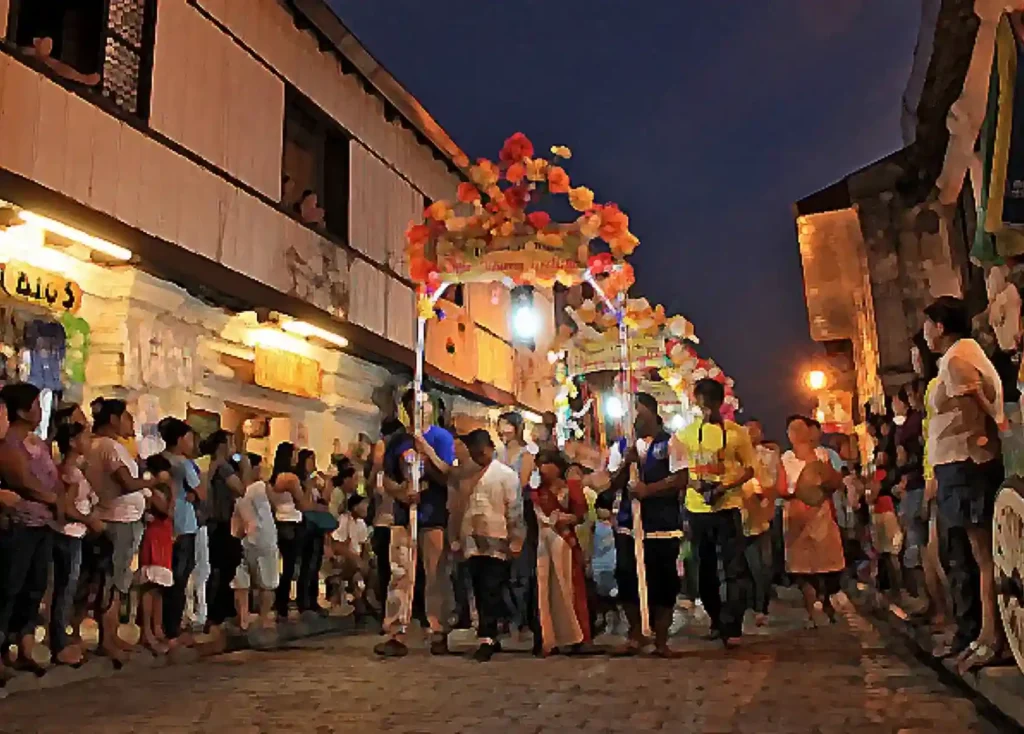
The climax of Flores de Mayo across the Philippines is the Santacruzan — a grand ritual pageant held on the last day of May. In Bohol’s towns, this procession fills the streets with colour, music, and a deep sense of history.
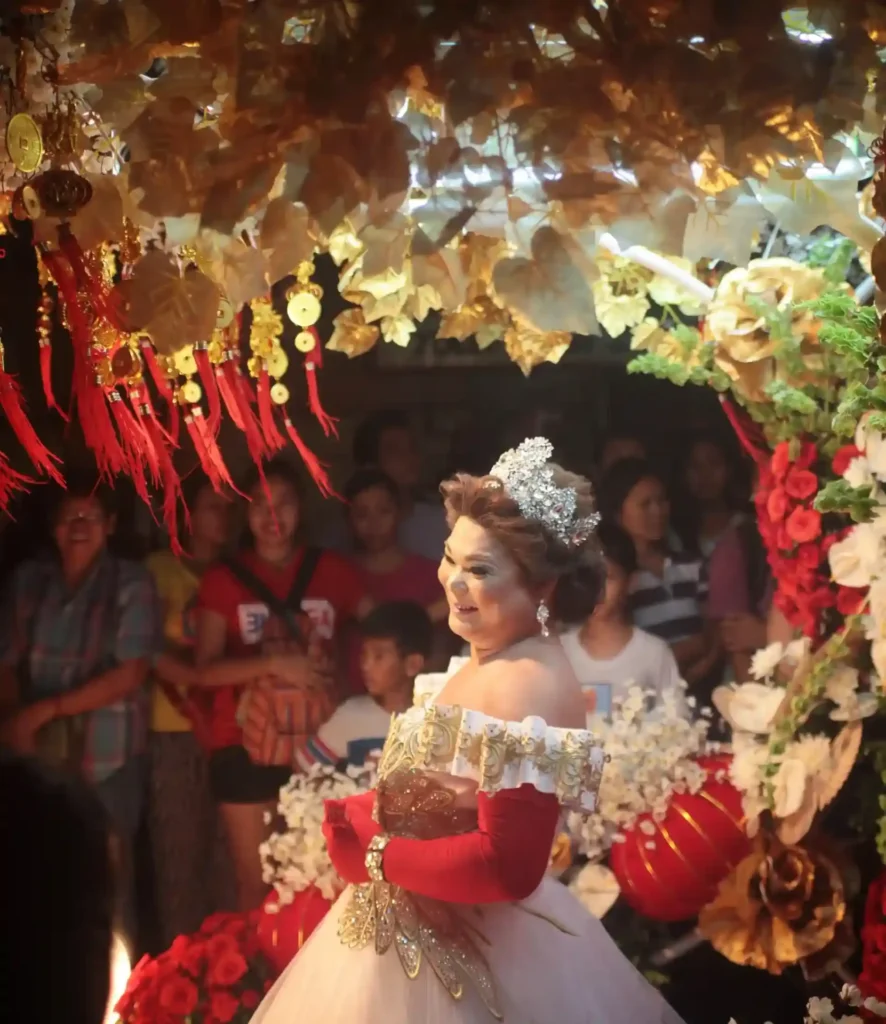
The Santacruzan commemorates the discovery of the True Cross by Saint Helena of Constantinople (Reyna Elena) and her son, Emperor Constantine the Great. The pageant re-enacts their legendary search, with a young woman playing Reyna Elena — robed in Filipiniana or a Renaissance-style gown, carrying a cross — as the centrepiece of the procession.
Walking ahead of her are a cascade of women and girls representing Marian titles and Biblical figures: Reyna Fe (Faith), Reyna Esperanza (Hope), Reyna Caridad (Charity), Rosa Mística, Reyna de las Flores, Reyna del Cielo — and many more. Each carries a symbol. Each wears an elaborate gown. In smaller towns, these roles are filled by local young women selected by the parish; in larger celebrations, the procession can include 30 to 40 participants.
The scent of assorted flowers — worn in the hair, carried in bouquets, woven into arches over the procession route — is the defining sensory detail of the Santacruzan. You smell it before you see it.
A brass band traditionally accompanies the procession, playing the Dios Te Salve (Hail Mary) hymn. In modern Bohol, you may also hear speaker trucks and contemporary religious songs mixed in. The procession begins and ends at the town church, closing with an evening Mass and often a communal feast.
Boys and men accompanying the procession typically wear the barong Tagalog. It is, without exaggeration, one of the most photogenic events in the Philippine Catholic calendar. Come with a charged camera.
Flores de Mayo at the Barangay Level
The evening church celebrations get the most attention, but Flores de Mayo in Bohol runs deeper than any single cathedral service.
In almost every barangay across the province’s 48 municipalities, a chapel, house of prayer, or local church serves as the daily gathering point. Each evening throughout May, children gather there for catechism — lessons on the life of Mary, Marian apparitions, Christian values, and the prayers sung exclusively during Flores de Mayo. They offer flowers before the image of the Virgin. Their mothers and grandmothers pray the Rosary alongside them.
This is not a formal school lesson. It is how Bohol passes faith from one generation to the next — in the familiar smell of candles and flowers, in the voice of an older woman leading a decade of the Rosary in Bisaya, in the specific prayers that children in Bohol have been memorising since the 1860s.
To keep the children engaged and reward their participation, many parishes give out paper tickets for each evening’s attendance. At the end of May — after the Santacruzan, after the crowning, after the final Mass — those tickets can be exchanged for school supplies. Notebooks, pens, crayons. It is a practical tradition as much as a spiritual one: a month of prayer becomes a head start on the school year.
Visitors who attend these barangay celebrations are often welcomed with generosity. Hermanos and Hermanas — lay leaders who sponsor and organise the evening prayers — typically provide merienda (afternoon snacks) to all who come. You do not need to be Catholic or Filipino to be welcome. You just need to be respectful.
Best Places to Experience Flores de Mayo in Bohol
Flores de Mayo happens everywhere in Bohol simultaneously — but some celebrations are worth planning around:
Talibon (Northern Bohol) — As described above, the Talibon Cathedral celebration includes a Pontifical Mass with the Bishop of Talibon and some of the most moving ceremonies in the province. Talibon is about 80 km from Tagbilaran City, roughly 1.5 to 2 hours by bus on the northern coastal road.
Tagbilaran City — The provincial capital’s celebrations are the most visible to visitors. The Tagbilaran cathedral and surrounding parishes hold daily evening novenas throughout May. The Santacruzan here is elaborate and well-attended. Tagbilaran is where most travellers arrive by ferry, making it easy to catch an evening celebration before or after sightseeing.
Loboc — This music-loving town in central Bohol brings its famous choral tradition to the May devotions. Explore the Loboc River cruise guide for more about this town’s unique cultural character. Loboc is 24 km from Tagbilaran, about 45 minutes by tricycle or habal-habal (motorcycle taxi).
Baclayon — Bohol’s oldest coral-stone church (built 1595) becomes even more beautiful when dressed for Flores de Mayo with garlands and flower offerings. The Baclayon travel guide details this heritage town’s full story. Baclayon is just 7 km from Tagbilaran City.
Smaller interior towns like Carmen (home of the Chocolate Hills), Inabanga, and Garcia Hernandez hold barangay-level celebrations that are quieter, more intimate, and often more rewarding for travellers who want to experience the festival the way locals do.
Practical Travel Tips for Flores de Mayo in Bohol
When to go: The entire month of May. The Santacruzan procession falls on the last day — May 31, or the nearest weekend depending on the parish. The children’s bazaar typically follows the day after. Cathedral celebrations at Talibon, Tagbilaran, and other major parishes are usually held in the late afternoon, from around 4 pm.
Getting to Bohol: Fast ferries run daily from Cebu City’s Pier 1 to Tagbilaran Port — roughly 2 hours, covering the 72 km channel between islands. Book your ferry tickets in advance for May travel, as the season is popular. For full transport logistics, see the Bohol transportation and ferry guide.
🔗 Secure your Cebu–Bohol ferry ticket via 12Go — instant booking confirmation →
Getting around: From Tagbilaran, public buses serve all major towns including Talibon (~₱120–160, 1.5–2 hours), Loboc (~₱40, 45 minutes), and Carmen (~₱60, 1 hour). Habal-habal (motorcycle taxis) are available for shorter distances and rural barangays. Tricycles are best for in-town movement.
What to wear: Dress respectfully for church visits — shoulders covered, no shorts inside the cathedral. Modest clothing is the norm during the evening Misa. Light cotton is your friend in May’s building heat (temperatures can reach 33–34°C in the afternoons in Bohol).
What to bring: A small offering of flowers is always appropriate and welcomed — roses, sampaguita, or any fresh blooms from the market. Arrive a few minutes early to get a good seat. If you are attending a barangay evening prayer session, a small contribution to the collection is a kind gesture.
Best time of day: The evening novenas and processions typically run from 4–7 pm. The heat of the afternoon has usually passed by the time the prayers begin.
Accommodation: May is the beginning of the transition season in Bohol — the amihan is winding down and habagat storms haven’t fully arrived yet. Hotel rates are starting to ease from Holy Week peaks. Panglao and Tagbilaran have the widest accommodation options. Browse the Bohol hotels guide for complete May accommodation options.
“We stayed a full week in Talibon and caught the Flores de Mayo celebrations every evening at the Cathedral. I had never felt so welcomed by a community I had only just arrived in. The ticket bazaar for the children was the most heartwarming thing I saw the entire trip.”
— James and Cora H., couple from Singapore ⭐⭐⭐⭐⭐
Plan Your Bohol May Itinerary Around Flores de Mayo
May is a wonderful month to visit Bohol beyond the festival itself. The countryside is still lush from the transition rains. The Chocolate Hills are at their greenest. The Loboc River cruise is magical in the soft morning light. Panglao Island is beginning to ease off Holy Week crowds. And the Bohol countryside tour — taking in the tarsier sanctuary, Baclayon Church, the Bilar man-made forest, and the river — gives you the full context of what makes this province so worth knowing.
For a curated overview of May activities, check the things to do in Bohol in May guide or the broader 77 things to do in Bohol resource.
🔗 Book the Bohol heritage churches tour on GetYourGuide — explore the Flores de Mayo venues →
🔗 Book the Bohol countryside day tour on GetYourGuide — Chocolate Hills, Tarsier, and Loboc River →
Frequently Asked Questions About Flores de Mayo in Bohol
What is Flores de Mayo in Bohol?
Flores de Mayo is a month-long Catholic devotion celebrated every May throughout the Philippines, including all of Bohol’s 48 municipalities. Each evening, communities gather at their parish churches and barangay chapels to pray the Rosary, sing hymns, and offer flowers before the image of the Virgin Mary. The celebration culminates on May 31 with the Santacruzan procession.
When exactly does the Santacruzan procession happen?
The Santacruzan is traditionally held on the last day of May (May 31), though some parishes schedule it for the final Sunday of the month. Individual towns may have slightly different schedules — check with the local parish or your accommodation for exact dates and times.
Can tourists attend Flores de Mayo and Santacruzan in Bohol?
Yes, absolutely. The celebrations are open to everyone. Travellers are welcome to attend the evening novenas, watch the Santacruzan procession, and observe the ceremonies. Respectful dress and a quiet, reverent demeanour are all that is expected. Many barangay events also welcome visitors with snacks and hospitality.
Which town in Bohol has the best Flores de Mayo celebration?
Talibon Cathedral has a particularly full and moving celebration, including a Pontifical Mass with the Bishop of Talibon. Tagbilaran City and Loboc are also known for well-organised, elaborately staged Santacruzan processions. For an intimate barangay experience, smaller towns like Carmen or Baclayon are excellent choices.
Is Flores de Mayo the same as Santacruzan?
No — though the two are closely connected. Flores de Mayo is the full month-long festival of daily prayers and flower offerings. The Santacruzan is specifically the ritual pageant procession held at the end of May, commemorating the finding of the True Cross by St. Helena. The Santacruzan is the grand finale of Flores de Mayo.
What is the role of children in Flores de Mayo?
Children are central to the celebration. Throughout May, they attend nightly catechism sessions at their barangay chapel or church, learning prayers, Marian songs, and the stories of the Blessed Virgin. They earn paper tickets for attendance, which they can exchange for school supplies at the end-of-May bazaar. It is both a religious and a community education tradition.
What do the Marian titles in the Santacruzan mean?
Each title represents a specific theological virtue or aspect of the Virgin Mary — Reyna Fe (Faith), Reyna Esperanza (Hope), Reyna Caridad (Charity), Rosa Mística (Mystical Rose), Reyna del Cielo (Queen of Heaven), and many more. Reyna Elena represents Saint Helena, who found the True Cross. Together, the procession is a living catechism — a visual walk through Catholic Marian devotion.
How do I get to Bohol for Flores de Mayo?
The main entry point is Tagbilaran City, reachable by fast ferry from Cebu City (about 2 hours). Regular ferry services operate daily. From Tagbilaran, buses, tricycles, and motorcycle taxis connect you to towns across the province. For complete transport information, see the Bohol transportation guide.
A Month Worth Travelling For
Flores de Mayo is not a performance put on for tourists. It is the living faith of Bohol — the same faith that built the coral-stone churches still standing after 400 years, that sends families to 4 am Masses in Loboc, that fills a cathedral in Talibon on a Tuesday evening in May just because Mary is their mother and May is her month.
When Bishop Noel translated Pope Francis’s homily line by line into Bisaya — so that every lola in that cathedral could understand every word — that was Flores de Mayo at its most essential. When the little angels scattered flower petals and the image was crowned, that was it too. When the children exchanged their tickets for school supplies the morning after — the practical, generous, deeply Boholano act of making faith useful — that was perhaps most of all.
If you are planning a trip to Bohol in May, build your itinerary around it. Come to one evening service. Stay for the Santacruzan. Let a stranger hand you a flower. You will not regret it.
Where to Stay for Flores de Mayo
May is the beginning of Bohol’s shoulder season — fewer crowds, lower rates, and authentic celebration atmosphere. Here are your accommodation hubs:
Planning to be in Bohol for Flores de Mayo? Tagbilaran is the best base — it’s close to the cathedral processions and has good transport links to all municipalities.
🔗 Compare Tagbilaran hotels on Booking.com — free cancellation →
🔗 Find Tagbilaran deals on Agoda — member prices available →
For beach-based stays, check the Panglao Island hotels guide for resort options just 45 minutes from Tagbilaran City.
Support our site by booking through our trusted affiliate partners. These links help us keep our content free while ensuring you get the best travel deals!
Related Articles
- Bohol Travel Guide — Your complete introduction to the island
- Things to Do in Bohol in May — Full May activities guide
- Tagbilaran City Guide — Where to stay, eat, and explore in the capital
- Loboc River Cruise and Travel Guide — Central Bohol’s most iconic day out
- Bohol Tours Hub — Book your Bohol activities in one place
- Bohol Hotels Guide — Where to stay for your May trip
- Bohol Attractions — Top sights and experiences across the province
“The Flores de Mayo in a small Bohol town was the highlight of our Philippines trip — more than any beach or dive site. The way the whole community came together, the flowers, the children’s voices — it was genuinely the most beautiful thing I witnessed in six months of travel.”
— Tom A., solo traveller from Australia ⭐⭐⭐⭐⭐
Frequently Asked Questions — Flores de Mayo
What is Flores de Mayo in Bohol?
Flores de Mayo is a month-long Catholic devotion celebrated throughout May across all of Bohol’s 48 municipalities. Each evening, communities gather at parish churches and barangay chapels to pray the Rosary, sing hymns, and offer flowers before the image of the Virgin Mary. Children attend catechism sessions and earn tickets that they exchange for school supplies at the end of May. The celebration culminates on May 31 with the Santacruzan — a grand procession celebrating the discovery of the True Cross.
When exactly does Flores de Mayo happen?
Flores de Mayo runs throughout the entire month of May, with evening novena prayers typically beginning around 4 to 5 pm. The Santacruzan procession falls on May 31, or on the nearest Sunday of that weekend, depending on the parish. Some towns schedule ceremonies slightly differently, so check with your accommodation or local parish for exact times. The celebrations begin at dawn with some parishes and continue with evening activities throughout the month.
Can tourists attend Flores de Mayo celebrations?
Absolutely yes. The celebrations are open to everyone regardless of faith background. Travellers are welcome to attend evening novenas, watch the Santacruzan procession, and observe the ceremonies. Respectful dress — shoulders covered, no shorts inside the cathedral — and a quiet, reverent demeanour are all that’s expected. Many barangay-level events also welcome visitors with merienda (snacks) and genuine hospitality.
Which towns in Bohol have the best Flores de Mayo celebrations?
Talibon Cathedral in northern Bohol features a full Pontifical Mass with the Bishop of Talibon and some of the province’s most moving ceremonies. Tagbilaran City, the provincial capital, holds elaborate daily novenas and well-attended Santacruzan processions — convenient for arriving travellers at the ferry terminal. Loboc, the music-loving town in central Bohol, brings its famous choral tradition to the May devotions. Baclayon with its 1595 coral-stone church becomes especially beautiful dressed with flowers and garlands. Smaller towns like Carmen offer more intimate, authentic barangay-level experiences.
Is Flores de Mayo the same as Santacruzan?
No — they are closely connected but distinct. Flores de Mayo is the entire month of May, with daily prayers, flower offerings, children’s catechism, and community gatherings. The Santacruzan is specifically the ritual procession held on the last day of May, featuring young women in elaborate gowns representing Marian titles and Biblical figures. Santacruzan is the grand finale of Flores de Mayo, not the whole celebration.
What is the role of children in Flores de Mayo?
Children are central to the celebration. Throughout May, they attend nightly catechism sessions at their barangay chapel or church, learning prayers, Marian songs, and stories about the Blessed Virgin Mary. Each evening they attend earns them a paper ticket. At the end of May — after the Santacruzan and final Mass — those tickets are exchanged for school supplies: notebooks, pens, crayons, and sometimes refreshments. It’s both a spiritual education and a practical community support system preparing children for the school year.
What do the “Reyna” titles in the Santacruzan mean?
Each “Reyna” (Queen) represents a specific theological virtue or aspect of the Virgin Mary. Reyna Fe is Faith, Reyna Esperanza is Hope, Reyna Caridad is Charity, Rosa Mística is the Mystical Rose, Reyna del Cielo is the Queen of Heaven, and Reyna Elena represents Saint Helena, who found the True Cross. Together, the procession is a living catechism — a visual walk through Catholic Marian theology and the theological narrative of the finding of the True Cross.
How do I get to Bohol for Flores de Mayo?
Fast ferries run daily from Cebu City’s Pier 1 to Tagbilaran Port — approximately 2 hours covering 72 kilometres. Book ferry tickets in advance for May travel, as the season is popular. From Tagbilaran, public buses connect to all major towns: Talibon (~₱120–160, 1.5–2 hours), Loboc (~₱40, 45 minutes), Carmen (~₱60, 1 hour). For rural barangay celebrations, habal-habal (motorcycle taxis) and tricycles are your best options. More details on getting to Bohol
What should I wear to Flores de Mayo celebrations?
Dress respectfully for church visits — shoulders covered, no shorts inside the cathedral. Light cotton clothing is essential, as May’s heat can reach 33–34°C in the afternoons. Evening celebrations usually begin after the hottest hours, so the comfort improves as the day progresses. Comfortable walking shoes are recommended if you plan to follow the Santacruzan procession through town streets. A modest, tidy appearance shows respect for the deeply spiritual nature of the celebration.
Should I bring flowers as an offering?
Yes — a small offering of flowers is always appropriate and welcomed. You can buy fresh blooms at any local market: roses, sampaguita, or other fresh flowers. Arrive a few minutes early to get a good seat, especially for cathedral celebrations. If you attend a barangay evening prayer session, a small monetary contribution to the collection is a kind and appropriate gesture that supports the parish and the children’s bazaar at month’s end.
Why is Flores de Mayo so important to Boholano culture?
Flores de Mayo marks the turning point of Bohol’s seasons — the moment the rains begin to bring the land back to life. For farmers historically, May represented the Virgin Mary’s intercession bringing the water their rice and coconut crops required. Faith in Bohol is never separate from everyday life, and Flores de Mayo weaves that spiritual understanding into every evening of the month. It’s how the province passes faith from grandparents to grandchildren — in the smell of flowers and candles, in shared prayer, in a community investing in its children’s spiritual and practical future.
Have more questions about travelling to Bohol? Visit our complete Bohol FAQ for answers to the most common questions travellers ask.