Bohol Kalamay: The Chemistry, Craft, and Culture of Jagna’s Indigenous Confection
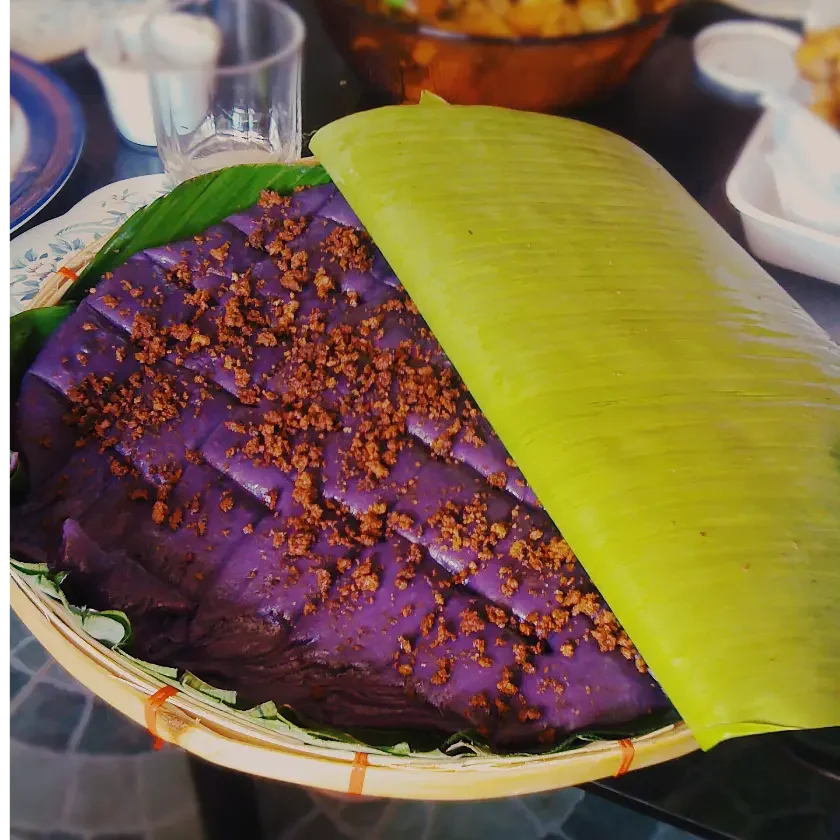
The wooden ladle never stops. For four hours — sometimes longer — a maker in Jagna stands over a clay-fired kawa (large wok), folding a thickening paste of coconut milk, glutinous rice, and muscovado sugar against the heat. The smell is not sweetness in the simple sense. It is the smell of chemistry: the Maillard reaction working on the proteins in the coconut milk, caramelization approaching but being pushed back by the constant motion of human hands. At some point — experienced makers recognize it before a thermometer would — the mixture crosses from viscous liquid to something else entirely. It stretches. It holds together under tension in a way that defies the texture of any other Philippine rice cake. It has become Bohol kalamay, and the science behind that transformation is more complex than the ingredient list suggests.
Jagna on Bohol’s southern coast
🏨 Find hotels in coastal Anda on Booking.com →
🏨 Compare coastal Anda resort prices on Agoda →
The Non-Newtonian Confection: What Gives Kalamay Its Stretch
Most foods that flow, flow. Kalamay does not behave this way. Classified technically as a non-Newtonian fluid, the finished paste exhibits shear-thinning behavior — it resists deformation under slow stress but yields under rapid force. This is the same category of material as dense cornstarch suspensions and certain industrial adhesives. The mechanism responsible is amylopectin.
Glutinous rice (Oryza sativa var. glutinosa) — called malagkit in Filipino — derives its name from the structural composition of its starch, not from any actual botanical relationship to gluten. Where standard long-grain rice contains roughly 80% amylopectin and 20% amylose, glutinous rice inverts this ratio almost entirely: amylopectin content exceeds 90%, with amylose reduced to trace levels. Amylopectin is a highly branched polymer — its tree-like molecular architecture creates chains that entangle with one another under heat and pressure, forming a cohesive, elastic matrix. When the starch is cooked into hot coconut fat and sugar, those chains lock together with unusual tensile strength.
This is why the stretch of properly made Jagna kalamay is not a texture trick. It is a consequence of molecular structure. The muscovado sugar — an unrefined cane sugar retaining its molasses content — contributes both sucrose and fructose, while the coconut milk introduces medium-chain triglycerides (MCTs), the saturated lipids that give the paste its glossy surface and dense mouthfeel. The four-hour reduction is not tradition for tradition’s sake. It is the minimum time required at boiling-point temperatures for the amylopectin chains to fully hydrate, the proteins to denature, and the lipid fraction to emulsify into a stable, non-separating structure.
Bohol food guide: where to eat across the island
[Technical Deep-Dive]
CHEMICAL & PHYSICAL COMPOSITION — JAGNA KALAMAY
- Oryza sativa var. glutinosa amylopectin content: >90% of total starch fraction; responsible for elastic, cohesive paste structure
- Processing temperature: maintained at 100°C (boiling point) throughout reduction; manual agitation prevents protein caramelization
- Lipid fraction: medium-chain triglycerides (MCTs) from Cocos nucifera milk; saturated fat content determines density and shelf stability
- Sugar matrix: sucrose + residual fructose and molasses from unrefined muscovado; contributes both sweetness and hygroscopic (moisture-retaining) properties
- Rheological classification: non-Newtonian fluid; exhibits shear-thinning behavior under stress
- Shelf life: 2 weeks unrefrigerated; 1 month+ refrigerated
Shell as Technology: What the Bagol Does That Plastic Cannot
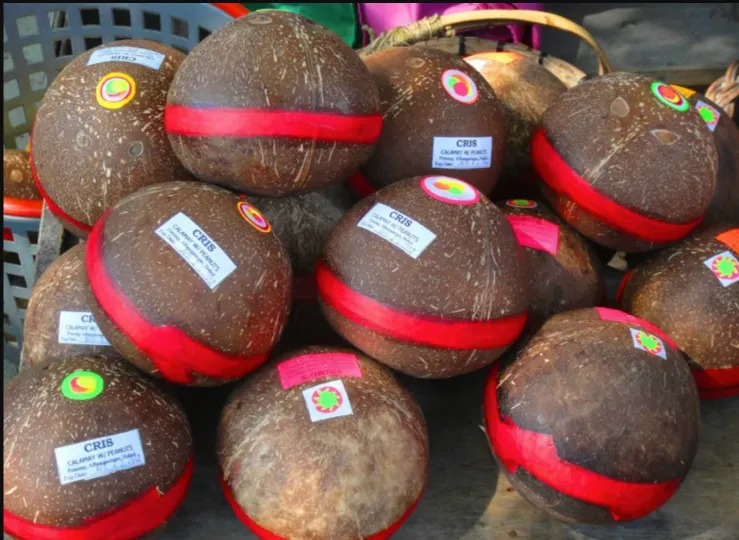
When the paste is done, it is spooned into a bagol — the polished hemispherical shell of a mature Cocos nucifera. The shell is then sealed with a paste made from crushed petals of Hibiscus rosa-sinensis, the red gumamela common throughout Bohol’s coastal municipalities. The seal dries to a rigid, herb-scented band around the equator of the shell. It is entirely organic, and entirely edible.
This packaging system predates plastic by centuries and achieves things plastic does not. The coconut endocarp — the hard inner layer of the coconut fruit — is highly lignified, meaning its cell walls are reinforced with lignin, the same structural polymer that makes wood rigid. At 10–15 cm in diameter, the hemispherical bagol is also mechanically efficient: the dome geometry distributes compression loads evenly across the surface, making it resistant to cracking during transport in wicker baskets and wooden crates along the old Loboc-Jagna road corridor.
The selection of the shell is not casual. Only shells from fully mature coconuts qualify. Young shells — still pale and relatively soft — are too porous. The mature endocarp has completed its lignification process, its micro-pores effectively sealed, creating what one DTI report describes as a container that “allows the product to breathe while maintaining a sterile interior.”
“We see the coconut shell not as packaging, but as a biological barrier that allows the product to breathe while maintaining a sterile interior.”
— DTI Regional Director, Central Visayas, 2019 Report
The counterintuitive implication: kalamay sealed in traditional bagol and gumamela paste lasts longer at ambient temperature than many modern packaging alternatives for comparable confections, without preservatives, because the shell’s micro-porosity allows just enough gas exchange to prevent pressure buildup from fermentation while the dried gumamela seal blocks aerobic bacterial pathways.
[The science behind] The “hermetic” nature of the Gumamela paste is not just a glue; it is a biopolymer seal. When the mucilage dries, it shrinks and tightens the bond between the two halves of the shell, creating a vacuum-like tension. This, combined with the shell’s ability to “breathe” without losing its internal moisture content, allows the kalamay to remain shelf-stable at ambient Philippine temperatures ($28$–$32$°C) for several weeks—often outlasting store-bought versions in thin plastic wraps that succumb to mold due to trapped condensation.
Bohol’s pasalubong and delicacies guide
Bohol’s Karst Kitchen: The Geological Basis of a Regional Taste
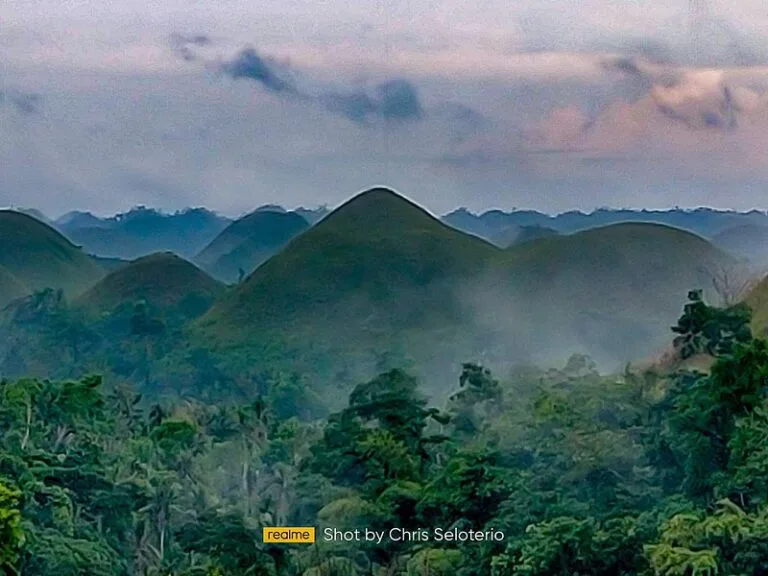
Jagna sits on the southern coast of Bohol, where the island’s characteristic uplifted limestone terrain meets the Mindanao Sea. The soil throughout this region — like the soil beneath the Chocolate Hills 40 kilometers to the northwest — carries an unusually high concentration of calcium carbonate (CaCO₃), the legacy of Bohol’s geological origins as an ancient seabed pushed above water during the Miocene epoch. The island’s famous karst landscape, including its 1,268+ limestone mounds, is the surface expression of this calcium-rich substrate.
The connection to kalamay is indirect but measurable in principle. Coconut palms (Cocos nucifera) growing in high-CaCO₃ soils uptake calcium differentially into their cellular structures. The mineral profile of the coconut milk — and consequently the lipid and protein ratios in the extracted cream — reflects the soil chemistry of the grove. Comparative lipid analysis between Bohol-grown and off-island coconut milk has not been formally published, but producers in Jagna have long maintained that coconuts sourced outside the region produce kalamay with a noticeably different consistency. The data brief identifies this as an open information gap: a formal chemical comparison between Jagna coconut milk and other provincial sources remains unpublished.
What is documented is the earthquake’s interruption of this geographic specificity. The magnitude 7.2 event of October 2013 — centered near the fault line bisecting the island — disrupted the Loboc-Jagna transport corridor and damaged traditional clay kilns throughout the municipality. The Department of Trade and Industry recorded a 30–40% supply chain disruption in kalamay production in the months following, from which output levels took approximately two years to recover.
Baclayon Church: 300 Years of Coral-Stone Faith
[Technical Deep-Dive]
PRODUCTION & PACKAGING SPECIFICATIONS — JAGNA KALAMAY
- Standard payong shell diameter: 10–15 cm (mature Cocos nucifera endocarp)
- Net weight per unit: 350–500 g
- Sealant: Hibiscus rosa-sinensis (red gumamela) petal paste; organic, edible, biodegradable
- Packaging structural geometry: hemispherical dome; distributes compression loads; resistant to in-transit cracking
- Supply chain impact from 2013 M7.2 earthquake: 30–40% disruption (DTI data); primary causes: clay kiln damage and Loboc-Jagna corridor blockage
- Cocos nucifera variety specification: mature shell only (bagol); immature shells excluded due to excess porosity
From Jesuit Trade Routes to JACAMCO: The Long History of a Jagna Confection
Kalamay as a category — sweet rice paste, cooked with coconut milk — appears across the Philippine archipelago under different names and with regional variations in composition. The specific Jagna variant, sealed in coconut shells and sold as pasalubong (a term for gifts brought home from travel, alongside Bohol peanut kisses and other regional sweets), carries a documented history traceable to the early 19th century, though its roots extend further.
Jesuit missionary records from the 17th and 18th centuries reference “sweet rice pastes” among the food preparations of the Visayas — a documentation consistent with the broad tradition of rice-and-coconut confections across the region — but do not isolate the Jagna process by name. The same Jesuit era that built Bohol’s remarkable network of Spanish colonial churches also carried food culture between island communities through the same inter-island trade routes.
The specific branding of Jagna as the kalamay capital of the Visayas appears to have solidified in the early 1900s, coinciding with the growth of inter-island trade along the southern Bohol coast. Jagna’s position as a port municipality made it a natural distribution point for goods moving between Bohol and the southern islands; the kalamay traveled with the boats. Today, Bohol’s southern ferry routes pass through Jagna — the same corridors that first carried kalamay across the Mindanao Sea.
“The Kalamay is not just food; it is a manifestation of the Jagnaanon’s patience. It is an edible archive of our 19th-century trade history.”
— Local Historian (Anonymous), Jagna Cultural Council
This cultural reverence is reflected across Bohol’s festivals and fiestas and in the central place kalamay holds in the island’s pasalubong shopping culture. The institutional infrastructure that now governs production — the Jagna Calamay Makers Cooperative, or JACAMCO — monitors production standards and advocates for quality controls that distinguish the traditional product from mass-market imitations. This distinction matters commercially: cheap versions of kalamay, produced with cornstarch or other thickeners in place of 100% glutinous rice, circulate in regional markets and in airport souvenir shops at lower price points, diluting both the product’s reputation and the livelihoods of Jagna’s artisanal producers.
Bohol Travel Guide: Plan Your Complete Bohol Trip
The Stirrer’s Paradox: Why Automation Has Not Replaced the Human Hand
Every few years, a government agency or private entrepreneur attempts to mechanize the kalamay stirring process. Every attempt has produced a technically inferior product.
The issue is not temperature control, which machines handle well. The issue is the specific motion: experienced producers describe the critical action not as simple rotation but as a folding — a figure-eight or lateral draw that aligns the amylopectin chains in a particular orientation during the final stage of the paste’s development. Mechanical agitators rotate, but they do not fold. The distinction appears to be consequential at the molecular level: the protein-alignment that creates kalamay’s characteristic stretch is sensitive to the directionality of the mechanical force applied during the final 30–60 minutes of cooking, when the paste transitions from semi-liquid to viscoelastic solid.
“The unique elasticity of Jagna Kalamay is a result of the precise ratio of amylopectin in the rice and the slow-rendering of coconut oils during the four-hour stirring process.” — Dr. Myrna Catane, Food Technologist
This is not a problem unique to kalamay. The artisanal food literature documents analogous failures in the mechanization of pulled noodles, hand-stretched taffy, and traditional mochi. In each case, the human hand introduces subtle asymmetries into the mechanical process that industrial rollers and paddles cannot replicate. Whether this is a feature of protein chemistry, polymer physics, or both remains an active question in food science. For Jagna’s makers, it functions as a natural economic moat: the product resists mass production not through intellectual property but through chemistry.
🔗 Book Chocolate Hills and Countryside Tour (GYG — May include kalamay tasting stop in Jagna upon request
Visitors who want to see the kalamay production process firsthand can book a Bohol countryside tour with a Jagna stop built into the route. For a curated selection, browse top countryside tours for first-time visitors or compare options on the best Bohol countryside tours page.
77 Things to Do in Bohol: The Complete Activity List
Conservation & Future: Three Hundred Makers and an Uncertain Succession
As of 2022, the Department of Trade and Industry recorded approximately 300 registered kalamay producers in Jagna — a figure that represents the formal, cooperative-linked sector. The actual number of household-level producers is higher and uncounted. The economic profile of most producers is small-scale: a clay kawa, a wooden paddle, a stock of mature coconut shells, and a market stall or home-based sale operation.
Three threat vectors currently compress this community.
The first is biological. The Coconut Leaf Beetle (Brontispa longissima), a Southeast Asian invasive species, has become an active pest pressure on Bohol’s coconut groves. Infestations damage young coconut fronds, reducing photosynthetic capacity and, over successive seasons, lowering both nut yield and the fat content of the coconut milk. The Philippines has active management protocols — principally biological control using parasitoid wasps — but the beetle’s spread remains uneven and difficult to contain in Bohol’s fragmented agricultural landscape. Similar biodiversity management frameworks underpin Bohol’s wildlife and ecotourism programs across the island.
The second is market dilution. Cornstarch-based imitations bearing the Jagna name circulate at lower prices in the same distribution channels as the authentic product. Without a Geographical Indication (GI) designation — a formal legal protection of the kind that protects Champagne or Parmigiano-Reggiano — Jagna kalamay has limited recourse against producers using the name without the process or the place. JACAMCO has advocated for GI registration with the Intellectual Property Office of the Philippines; the application status remains unresolved as of this writing.
The third is generational. The four-hour stirring process — physically demanding, low in hourly wage equivalent, and dependent on embodied skill developed over years — is difficult to recruit for. A 2022 survey of Jagna producers cited by the DOST regional office found that fewer than 20% of active makers had trained a successor from the next generation. The Department of Science and Technology’s mechanization initiative aims to reduce the labor intensity of the stirring phase while preserving product quality — the same goal that has defeated previous automation attempts.
What remains unknown is whether DOST’s current approach, which uses variable-speed agitators programmed with hand-motion data from experienced makers, can replicate the folding action sufficiently to satisfy both the chemistry and the cooperative’s quality standards. Field trials are ongoing as of this writing; no published result has confirmed success.
🔗 Bohol Eatwith Tours: Markets, Pasalubong & Culinary Day Trips
Bohol Municipalities: All 48 Towns of Bohol Explained
Tagbilaran City Guide: Where to Stay, Eat & Explore
Frequently Asked Questions — Bohol Kalamay
What is Bohol kalamay, and what makes it special?
Kalamay is a traditional Filipino sticky rice cake made from glutinous rice (malagkit), fresh coconut milk, and muscovado sugar, slow-cooked for up to four hours over an open flame. Bohol’s version — centered on the municipality of Jagna on the island’s southern coast — is widely regarded as the Philippines’ finest. What sets Jagna kalamay apart is its texture: the finished product has an extraordinary elastic stretch that commercial versions, made with cornstarch shortcuts, cannot replicate. It is the most iconic pasalubong (souvenir food gift) you can carry home from Bohol.
What gives Jagna kalamay its distinctive stretch?
The stretch is a consequence of molecular chemistry, not a secret technique. Glutinous rice (Oryza sativa var. glutinosa) contains more than 90% amylopectin — a highly branched starch polymer whose chains entangle and lock together under heat and sustained stirring, forming an elastic, viscoelastic matrix. Cooking the starch slowly into hot coconut milk and muscovado sugar over four hours gives those amylopectin chains time to fully hydrate and bond. Cornstarch-based imitations cannot replicate this because cornstarch has a structurally different starch profile — it simply cannot form the same tensile network.
What is the traditional coconut shell container for Jagna kalamay called?
The container is called a bagol — a polished hemispherical shell from a mature coconut (Cocos nucifera). It is sealed with a paste made from crushed Hibiscus rosa-sinensis (gumamela) petals, which dries to a rigid, herb-scented band around the equator of the shell. Only shells from fully mature coconuts qualify — young shells are too porous. The mature endocarp allows just enough gas exchange to prevent fermentation pressure from building, while the dried gumamela seal blocks bacterial pathways. Traditionally packed bagol kalamay lasts up to two weeks at room temperature with no preservatives.
Why can’t Jagna kalamay be made by machines?
Every attempt to mechanize the stirring process has produced an inferior product. Temperature control is not the problem — machines handle that fine. The issue is the stirring motion itself. Experienced makers use a folding action during the final 30–60 minutes of cooking that aligns amylopectin chains in a specific orientation as the paste transitions from semi-liquid to solid. Mechanical agitators rotate; they cannot fold. Even DOST-funded variable-speed agitators programmed with hand-motion data from experienced makers have not yet confirmed a successful replication of the characteristic stretch. The product resists mass production through chemistry, not copyright.
Where is the best place to buy authentic kalamay in Bohol?
The best source is Jagna Public Market, approximately 60 kilometers east of Tagbilaran City along the coastal highway. Prices are lower than anywhere in Tagbilaran, and the kalamay sold here is produced by JACAMCO-linked makers who follow traditional glutinous-rice standards. If Jagna isn’t on your itinerary, Tagbilaran’s Dao district pasalubong shops carry a solid selection, as do most countryside tour stops. Wherever you buy, always ask specifically for malagkit-based (glutinous rice) kalamay — not the cheaper cornstarch version that circulates in the same channels. The Bohol travel guide has more on shopping across the island.
How far is Jagna from Tagbilaran City, and how do I get there?
Jagna is roughly 60 kilometers east of Tagbilaran City — about a 1.5-hour drive by private car or van along the coastal highway. By Ceres bus from Tagbilaran’s main terminal, the journey takes 1.5 to 2 hours and costs approximately ₱80–₱120. The road itself is one of the most scenic on the island, passing rice paddies, mangrove coastlines, old stone churches, and quiet fishing villages all the way east. If you’d prefer to leave the logistics to someone else, some Bohol countryside tours include an east Bohol leg with a kalamay tasting stop in Jagna — worth asking about when you book.
How long does Bohol kalamay last, and can I bring it on a plane?
Shelf life is approximately two weeks unrefrigerated for traditionally packed bagol kalamay, and one month or more refrigerated. For international travel, look for commercially vacuum-sealed pouches with a printed best-before date — these are the better option for customs clearance. Kalamay is generally permitted in both checked and carry-on luggage for Philippine domestic flights. For international flights, check your destination’s biosecurity rules: Australia and New Zealand have strict food import restrictions. Sealed, labeled pouches clear customs far more easily than unwrapped bagol shells.
Is Jagna worth visiting for a day trip from Tagbilaran?
Easily. Jagna is the natural gateway to east Bohol’s best off-the-beaten-track experiences. From the market, it’s 20 kilometers further east to Candijay for Can-umantad Falls — one of Bohol’s tallest waterfalls — and another 30 minutes onward to Anda, Bohol, a tranquil beach destination with crystal-clear water and a fraction of Panglao’s tourist traffic. The full east Bohol loop (Jagna → Candijay → Anda) combines food, nature, and coastal scenery into a full day out. A kalamay run to Jagna very naturally becomes one of the better day trips you can plan from Tagbilaran.
What threats does traditional Jagna kalamay production face today?
Three pressures currently compress the producer community. The Coconut Leaf Beetle (Brontispa longissima) — a Southeast Asian invasive pest — threatens Bohol’s coconut groves by lowering both nut yield and the fat content of the coconut milk that defines kalamay’s flavor. Market dilution is a second threat: cornstarch-based imitations bearing the Jagna name circulate at lower prices in the same distribution channels as the authentic product, and without a Geographical Indication (GI) designation, JACAMCO has limited legal recourse. Third: fewer than 20% of active Jagna makers had trained a successor as of the last DOST survey — the four-hour stirring process is physically demanding and difficult to recruit for.
What other Bohol pasalubong pairs well with kalamay?
The natural companion is Bohol peanut kisses — the island’s other iconic souvenir sweet, also made by hand from local ingredients and equally resistant to mass-market mechanization. Most Jagna market stalls and Tagbilaran pasalubong shops carry both side by side. Beyond sweets, tablea (cacao tablets for traditional hot chocolate), bulad (dried fish), and native rice cakes round out a well-balanced haul. If you’re buying in Jagna, the public market also stocks local seafood and native snacks rarely found in Tagbilaran city shops — worth exploring while you’re there.
Have more questions about travelling to Bohol? Visit our complete Bohol FAQ for answers to the most common questions travellers ask.